 |
|  |


|
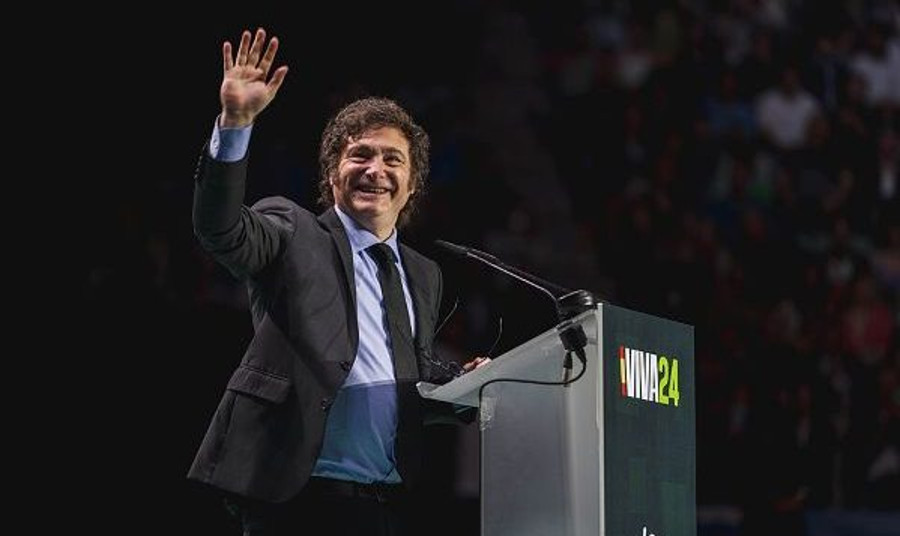
The failure of Javier Milei’s populist right government and the lie of his anti-establishment rhetoric According to Milei the ruling class would have to pay for the irresponsibility of recent years. This was the central theme of his campaign, and many believed him. Large sectors of the population voted for him because they hoped for “change”, desperate for solutions to the disastrous Peronist government of Alberto Fernández and the traditional right wing led by Mauricio Macri. The rise in food prices was brutal, with the arrival of the “libertarians” to power, while wages remained below the inflation line. Then came cuts to health, education, and social assistance. The government eliminated state coverage for medications, subsidies for electricity and gas, and food for community kitchens. Furthermore, he promoted lower taxes on higher salaries and corporate activity; eliminating, for example, the tax on high-end cars, yachts, etc. After 30 months in office, economic activity has fallen to alarming levels. Around 25,000 businesses have ceased operations, and so far in 2026, 2,000 businesses have closed each month. Milei’s economic programme is based on a policy of submission to the interests of large economic groups and transnational corporations. Privatization processes of public companies and the handover of natural resources have been promoted, facilitating speculative business. The liberalization of international trade has stimulated the massive importation of products, destroying national industry. As a result, the economy has contracted by 2.7% in the first quarter of 2026, and all economic indicators show a decline compared to 2025. Neoliberal governments come in with beautiful promises but the economic measures they have introduced have proven to be a failure where they have been implemented. They run headlong into a system in permanent crisis, and then they resort to whatever they can get their hands on to try and sustain a very poor mandate. Lowering public spending and cutting social spending is what these neoliberals resort to. This system needs uninterrupted growth, otherwise it begins to die. The entire struggle of right-wing governments revolves around this: growth and “security.” Unable to meet their targets and to avoid the so-called fiscal deficit, they resort to reducing public spending, which is nothing more than cutting funding for healthcare, pensions, medicine, and education. The economic indicators presented by Javier Milei’s administration are disastrous for Argentina. Investment in public works has fallen by almost 80%. In 2023, it represented 1.6% of the Gross Domestic Product (GDP); today it is barely 0.3%. This is of great importance, as public works have a strong impact on the labour market and job creation, stimulating, for example, the construction sector and the entire supply chain of industries that support it. 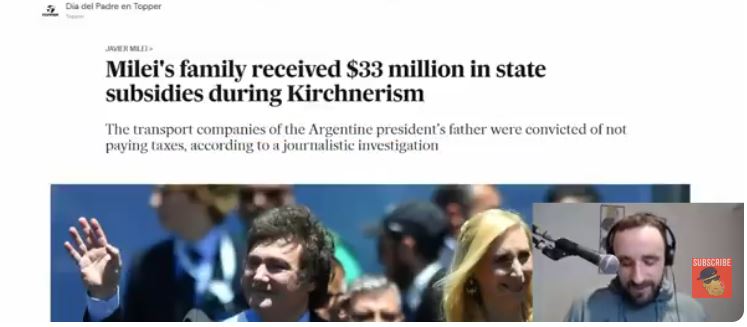
Fall in consumption and increase in poverty According to the consulting firm Scentia, sales fell 3.8% year-on-year in April, with the steepest declines in categories such as beverages and impulse items (sweets). Supermarkets have reported drops exceeding 7% compared to 2015. On the other hand, the consulting firm Zuban Córdoba has reported that poverty rose to 29.9% in the last quarter, adding 1.2 million new people to the ranks of the poor in just a few months. The most alarming figure is that among young people aged 15 to 29, poverty now affects 32.6%. To get a clear idea of the population’s suffering, it’s worth noting that the minimum living wage is a mere 357,800 pesos (approximately US$250). This means that a worker earning the minimum wage barely covers 25.6% of what their family needs to avoid poverty. On the other hand, the promise to “sweep away the elite” resulted in a series of corruption scandals involving Javier Milei himself, his sister Karina, and other members of his government. The infamous LIBRA cryptocurrency scam, promoted by Milei on his social media, is still under investigation. The president’s sister has been implicated in a bribery scheme involving the purchase of medicines at the National Disability Agency, where non-public tenders, pricing, and the collection of illegal kickbacks from laboratories and pharmacies are being investigated. Leaked audio recordings indicate that these illicit fundraising manoeuvres were intended for her. Chief of staff Manuel Adorni is also the subject of a judicial investigation prompted by complaints about the excessive level of spending on international trips, the high cost of which were paid in cash and do not match his declared income as a public official. As an example, Adorni’s salary as a public official is $7,100,000 (Approx. US$5,000per month ). This amounts to approximately $212,000,000 since he took office, and he has had expenses for travel and property purchases of approximately $1,100,000,000, without being able to justify the origin of the money spent. A government in crisis and the need for a revolutionary alternative Milei’s economic program has proven to be a complete failure. Were it not for the financial bailouts from the IMF, the World Bank, and the US Treasury, the government would have already fallen. These bailouts were agreed upon in exchange for a programme of plundering natural resources and massive privatizations. In addition to the economic crisis, rising unemployment and poverty, the scandalous corruption cases linked to the core of the government are severely impacting support for the government. Polls show a 60% disapproval rating for the government. This has been reflected in the massive social mobilizations of recent weeks against social spending cuts. This situation is provoking a “civil war” within the government, while the ruling class seeks alternatives to Milei to continue its neoliberal policies in the future. It is becoming increasingly clear to the population that this government has turned out to be part of the same caste that they supposedly came to eradicate. A period of enormous upheaval is now beginning, one that could lead to social explosions like the one that occurred in 2001 under the government of Fernando de la Rúa. In this period five presidents succeeded one another in just 11 days. Hence the urgency of building a genuine revolutionary alternative, responding to the most deeply felt demands of the Argentine people, in order to break with the cycle of permanent crisis and poverty that capitalism represents. This is clearly reflected in the level of popularity that the deputy of the Socialist Workers’ Party, (PTS), Myriam Bregman, has reached. In the polls she is now seen as the political leader with the most positive image in the country. The PST is a Trotskyist party, previously known as the Workers Party for Socialism, which is part of the Workers’ Left Front (FIT-U) along with the Workers’ Party (PO), the Socialist Left (IS), and the Workers’ Socialist Movement (MST). In this context, enormous possibilities open up for the left within the FIT-U. It will be necessary, then, to learn from this crisis and develop a revolutionary proposal geared towards the masses, who are increasingly disillusioned with the dead end offered by Peronism. Its support in recent polls has increased to up to 15%. It needs to develop into a party of the working class with a socialist programme for the struggles of the working class and masses and fight for a government of the workers’ and the poor going beyond an electoral alliance of different Trotskyist parties. Only the struggle for a workers’ government, which defends socialist policies, will be able to transform this crisis of the regime into a revolutionary solution, favorable to the exploited majorities. https://www.socialistworld.net/2026/06/17/the-failure-of-javier-mileis-populist-right-government-and-the-lie-of-his-anti-establishment-rhetoric/? Back |
|
||||||
Thanks for visting the G20 From Below Website. If you want something published here or other enquiries mailto:Brics-from-below@protonmail.com
|
|||||||